

Throughout the year, dozens of months, weeks, and single days are set aside to raise awareness for a specific mental health condition, population, or cause, everything from Mental Health Awareness Month in May to World Bipolar Day in March. Each one exists for the same basic reason: to get people talking about something that’s too often kept quiet, and to point people toward support they may not know is available.
We put together this mental health awareness calendar to make it easier to follow along throughout the year, whether you’re a patient, a caregiver, a provider, or just someone who wants to know what’s being recognized and why. Below, you’ll find a month-by-month look at the observances most relevant to mental health, along with where to turn if any of them speak to something you or someone you love is going through.
You don’t need to know every date by heart, and you don’t need to wait for the “right” month to ask for help. Think of this calendar less as a strict schedule and more as a set of reminders, scattered throughout the year, that whatever you’re dealing with, someone else is almost certainly dealing with it too.
Happening Now: National Wellness Month
Right now, we’re in the middle of National Wellness Month, observed every August. It’s a reminder to pause and check in with yourself: self-care, healthy routines, stress management, and anything else in service of your overall well-being. It’s a lighter, broader observance than most of the ones below, but it’s a fitting reminder that mental wellness isn’t only about diagnosis and treatment. Sometimes it’s just about building better habits before things become harder to manage.

The Full Year, Month by Month
January
January kicks off the year with Mental Wellness Month, a broad, hopeful observance about building healthy habits early. It’s also home to No Name-Calling Week, which focuses on reducing bullying in schools, a topic closely tied to youth anxiety and depression. For a lot of families, January is also when New Year’s resolutions naturally turn into a first conversation about getting support.
February
February includes International Boost Self-Esteem Month and Teen Dating Violence Awareness Month, along with National Eating Disorders Awareness Week. Together, they highlight three areas that disproportionately affect teenagers and young adults: self-image, relationship safety, and disordered eating.
March
March is a big month for specific conditions. World Bipolar Day falls on March 30, drawing attention to bipolar disorder treatment and the importance of an accurate diagnosis. Sleep Awareness Week (early March) is a good reminder that insomnia and other sleep issues are treatable, not something to just push through. March also marks Self-Harm Awareness Month.
April
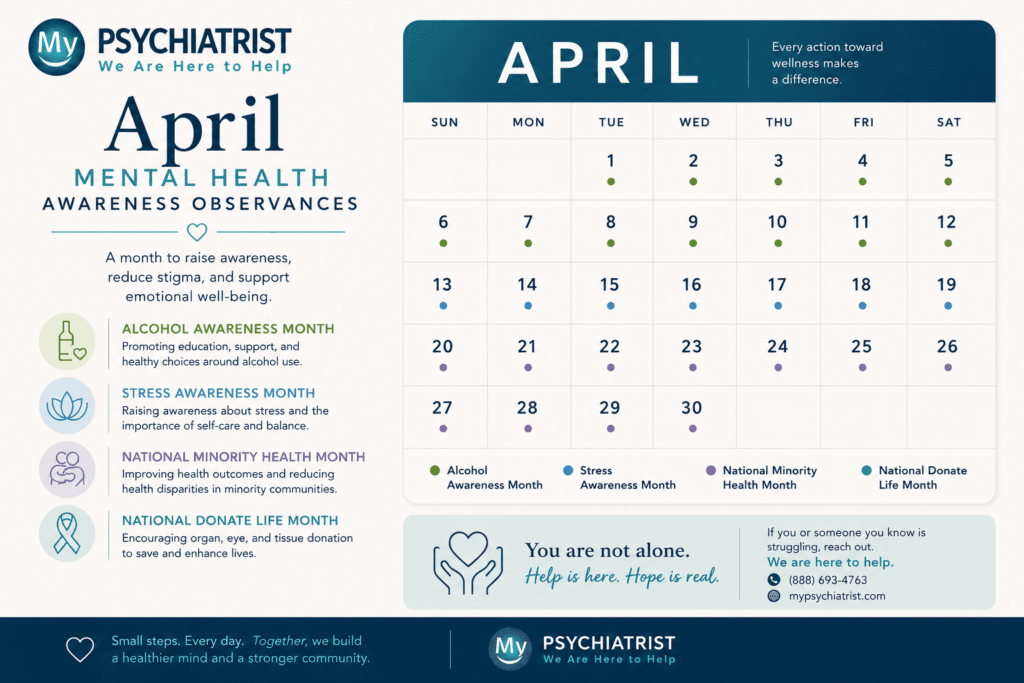
April covers a lot of ground, including Alcohol Awareness Month, Stress Awareness Month, and National Counseling Awareness Month. For patients managing both a mental health condition and a substance use disorder, this is a natural time to learn more about dual diagnosis treatment, an approach that treats both conditions together rather than one at a time.
May
May is Mental Health Awareness Month, the most widely recognized observance on this entire calendar, alongside National Children’s Mental Health Awareness Day and World Maternal Mental Health Day. That last one matters more than people realize: postpartum depression is common, treatable, and nothing any parent should have to white-knuckle through alone.
June
June is best known for PTSD Awareness Day on June 27, a reminder that trauma doesn’t have to be treated in silence, and effective PTSD treatment is available. June is also LGBTQ Pride Month, a population that faces meaningfully higher rates of anxiety and depression than the general public.
July
July recognizes Minority Mental Health Awareness Month, focused on the access and cultural barriers that keep many communities from getting the mental health care they need. It’s a good moment to highlight options like telepsychiatry, which can close some of that gap for patients who face transportation, scheduling, or stigma-related barriers to in-person care.
August
August is National Wellness Month, a month-long nudge to build sustainable habits around sleep, stress, movement, and connection, the everyday foundation that clinical treatment builds on top of.
September
September carries some of the most important observances on the calendar: National Recovery Month, National Suicide Prevention Month, and World Suicide Prevention Day on September 10. September is also a natural moment to talk about dual diagnosis treatment again, since recovery from substance use so often depends on treating any co-occurring mental health condition at the same time.
October
October is packed: ADHD Awareness Month, Mental Illness Awareness Week, OCD Awareness Week, World Mental Health Day (October 10), and National Depression Screening Day. If you’ve been putting off an ADHD evaluation, an OCD diagnosis, or a depression screening for yourself or your child, October is as good a reason as any to finally schedule it.
November
November includes International Stress Awareness Day and Hunger and Homelessness Awareness Week, a pairing that’s a good reminder that mental health doesn’t exist separately from housing, food security, and financial stress. It’s also, for a lot of people, the start of a stressful few months leading into the holidays, which makes it a good time to line up support before things get harder rather than after.
December
December closes the year with National Stress-Free Family Holidays Month, an acknowledgment that the holidays, however joyful, can also be one of the most stressful stretches of the year for a lot of families.
Why These Observances Matter
None of these months, weeks, or days change what’s actually involved in treating a mental health condition. What they do is create a moment, sometimes just one day a year, when a topic that usually stays quiet gets talked about openly. For someone who’s been quietly struggling with anxiety, PTSD, bipolar disorder, or a substance use issue, that moment of visibility is sometimes what finally makes reaching out feel possible.
That’s really the purpose of this calendar: not just to mark dates, but to make sure that whenever one of these observances comes around, there’s a clear next step for anyone who needs it. And if none of these dates line up with what you’re going through right now, that’s fine too. You don’t need an official observance on the calendar to justify reaching out; every day is a reasonable day to ask for help.
What is Mental Health Awareness Month?
Mental Health Awareness Month is observed every May in the United States. It’s the most widely recognized mental health observance of the year, intended to raise awareness, reduce stigma, and connect people with resources and treatment.
When is Mental Health Awareness Month?
Mental Health Awareness Month takes place every May.
What is National Wellness Month?
National Wellness Month is observed every August. It focuses on self-care, healthy routines, and stress management as everyday habits that support mental and physical well-being.
Where can I find a full mental health awareness calendar?
This page covers the observances most relevant to mental health care throughout the year. For an even more complete academic-style calendar, see Washington College’s Mental Health Awareness Calendar, one of the sources we referenced in putting this list together.
Why do mental health awareness months, weeks, and days matter?
They create visibility for topics that are often kept private, reduce stigma, and remind people that support and treatment are available. For many people, an awareness observance is the moment that finally makes it feel okay to reach out for help.
How can I get involved during a mental health awareness observance?
You can start by learning more about the specific condition or population being recognized, sharing accurate information, supporting a related nonprofit or walk, or simply checking in on someone you know who may be struggling. If you or someone you love needs care, scheduling an appointment is a meaningful way to participate too.
Ready to Talk to Someone?
You don’t have to wait for a specific awareness month to reach out. Whatever brought you to this calendar, whether it’s a date that resonated with your own experience or a condition affecting someone you love, our team is here whenever you’re ready to take that next step.
Ready to schedule an appointment? Contact My Psychiatrist to connect with a provider, or explore telepsychiatry if a virtual visit fits your schedule better.